
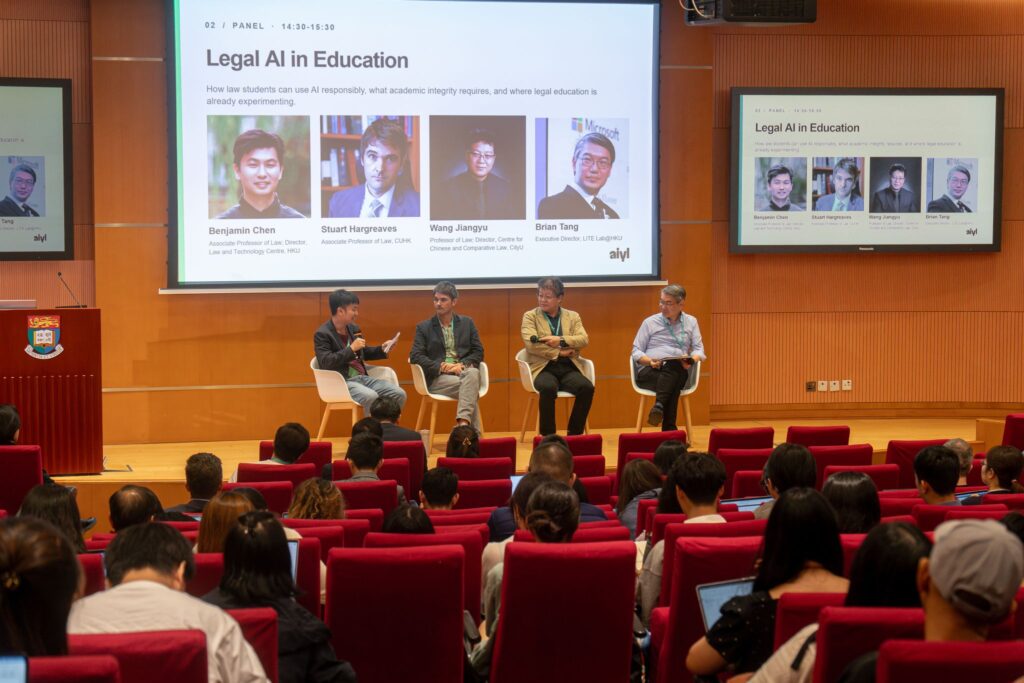
The Law and Technology Centre, HKU Faculty of Law and Casebyte co-organized an afternoon forum, “AI for Young Lawyers” for law students and young practitioners to explore how AI is changing legal education and their future careers on 15 August 2026 at Philip K. H. Wong Theatre, HKU.
The forum consisted of four panels, discussing “Frontier Legal AI Landscape”, “Legal AI in Education”, “Don’t Wait for Legal Tech: Build Your Own”, “Essential AI Skills for Young Lawyers” and a networking session. Panel 2 “Legal AI in Education” kicked off with a fun look back at our professors’ own law school days: what has changed and what hasn’t?
“Treat AI like a gym spotter. Let it push you beyond your limits but don’t let it do all the lifting. Otherwise you miss the whole point of workout.” Professor Benjamin Chen of HKU Faculty of Law walked us through grounded advice for law students: build broad and deep knowledge of legal rules, understand why they exist and how different areas of law connect. More importantly, read cases and academic literature to develop sound judgment needed to tell whether an AI-generated answer actually holds up.
Professor Stuart Hargreaves, Faculty of Law, The Chinese University of Hong Kong, impressed us with the sharp observations from his self-developed course chatbot. About a third of students in his class used the tool, and among them, he found out that the way students used it varied widely – from simple summaries and direct answers, to deeper back-and-forth discussions of legal concepts. The cold reality, or perhaps a refreshing one, is that “AI doesn’t erase the differences between students. If anything, it makes those differences clearer through how effectively they use the tools.”
“You must learn to use AI, but use with self-discipline: always try the question yourself first, then compare your answer with AI’s and see where you can improve.” Professor Jiangyu Wang of City University of Hong Kong, adapted to the shift by moving away from conventional written assignments. As he put it, “AI can now produce B, B+, or even A range legal analysis.” So he is bringing more role-play and structured debate into class to make oral judgment a stronger test of real ability.
“Technology should be integrated across doctrinal courses, starting with no-code and low-code tools, rather than taught only as a specialised elective.” Mr Brian Tang of HKU Faculty of Law visioned a clearer path for how AI should enter law courses. In his LITE Lab HKU, students work with NGOs and companies to solve real problems, build prototypes and develop AI-enabled workflows. The process itself is extremely rewarding: students learn from actual use cases, and that institutional knowledge has become more valuable than ever.
For more post-event information, please visit the LinkedIn of Law and Technology Centre.
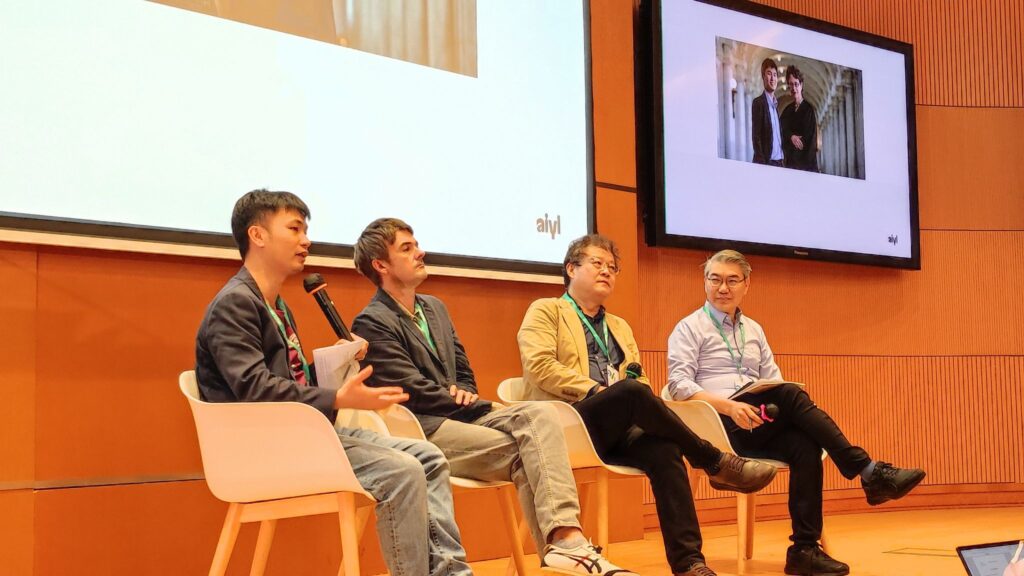
Photo from left: Professor Benjamin Chen; Professor Stuart Hargreaves; Professor Jiangyu Wang; Mr Brian Tang